Showing posts with label wool. Show all posts

8.31.2010

shearing lambs


Just outside of my hometown lives a woman and her sheep. Mrs. Hamilton and her flock have provided me with most of the wool I've spent so much time washing. She used to throw it to the woods to compost and let the birds have their pick for nests after the annual shearing until my dad got wind of this and mentioned she and I should get to know each other. We did and not only did she offer to let me have it, but also delivered it. Such generosity!

As most shepherdesses do, she shears her flock in the spring, but she invited me at the beginning of the summer to help her liberate the lambs from their woolen coats before the harsh Florida heat set in. In the past she's lost a few to stress this time of year and hoped to avoid loss this year. It was my first time meeting the flock, and though we only handled the just weaned lambs I completely fell for them all. The ewes rested happily on the the other side of the fence just in sight and the lambs were lovely sweet things that nibbled my pant leg and Maaa'd! piteously when we haltered them and led them to the shearing area. With their shepherdess mama at their heads they were quite calm even if not entirely pleased with the whirring of the heavy duty shears.

Shearing was hot, tiring and total bliss. The concentration required is the same beautiful focus as sculpting or drawing. It's a study in unveiling a tender form: anticipate where the edges of bone rest directly against skin to avoid prodding with the steel teeth of the comb, manipulate the loose skin around the elbows to prevent pinching by the blades, soothing over the thin skin of the belly taut against the gut. The knowledge imprints on us wholly, in a way that just glancing at the animal in the field can never do.


Lifting their heads with one hand as I slid the shears against their necks elicited a visceral response . . . so near to the act of slaughter and yet entwined in protection. Both are shepherding in the most sacred of senses.
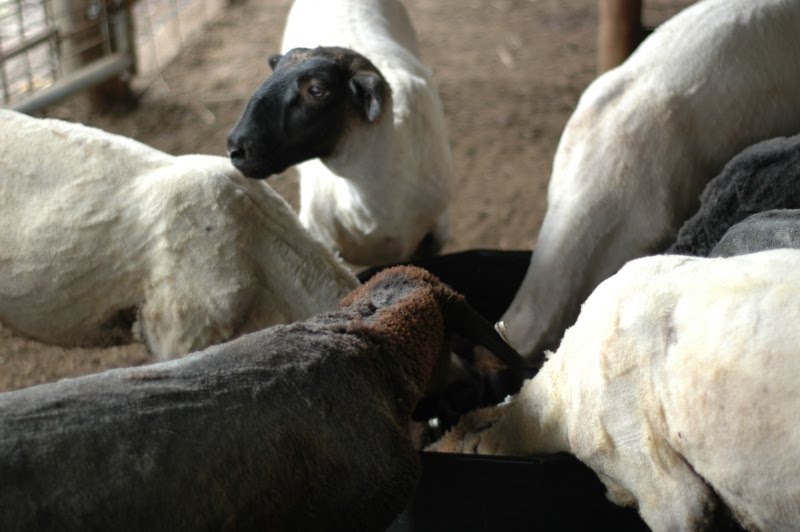
The black one in the front is PeeWee; he was just one pound at birth and survived with the help of bottle feeding.
This one was discovered to be dappled underneath. A watercolor lamb. . .As we finished up and gathered up the bag of short lambswool, the skies darkened and Mrs. Hamilton led her oldest charge, a thirteen-year-old blind ewe to shelter. The ewe of clouded eye tiptoed into the barn among bales of hay and and settled in her own private stall built of hay bales, nibbling feed as the rain began to fall.
I'll return in spring.

7.19.2010

"When it rains, sheep become self-cleaning."

Over the last year one of my major ongoing studio tasks been washing loads of raw wool one after the other in my bathtub. I've been scouring them which means soaking the wool in hot water and detergent for a time, pulling them out while the water is still hot, draining them and the tub and repeating til the water is clear and then giving a couple rinse soaks at the end for good measure. It's work that uses a lot of hot water and detergent, means the bathtub is constantly full of wool in various states of dirty and, most importantly, any other work I'm doing is constantly interrupted to tend to it.

Recently I stumbled across about the Fermented Suint Method which seemed like a promising method to make the process more efficient. The Fermented Suint method was developed in New Zealand and involves soaking dirty raw wool in rainwater for several days. This works because of the self cleaning properties of wool. Judith MacKenzie McCuin explains:

"In addition to the coating of lanolin that happens during the passage through the tube of the [hair] follicle, wool is coated with a substance called suint.

Secreted from a gland similar to a sweat gland, suint is applied just before the fiber exits the skin. Suint is liquid at room temperature and hardens as it moves up the shaft of the fiber, away from the sheep's body heat. Like soaps and detergents, which are made from either sodium or potassium salts, the chemical composition of suint is primarily potassium salts, making suint a natural detergent. Unlike lanolin, suint is water soluble. Like all other soaps and detergents, suint naturally attracts dirt and surrounds it, moving the dirt up the wool shaft by osmosis towards the tips of the fleece. When it rains, sheep become self-cleaning. The rain activates the soapy qualities of the suint in the tips of the fleece and washes away much of the dirt. " ("On Washing Wool" Spin-off magazine, Fall 2008)

She goes on to mention that pioneers would run the sheep through rivers or creeks before shearing to wash the wool.

This is the first batch of fleece, which has been sitting in water for five days and is ready to come out. Future fleeces only need two days in the same bath of water.

That film on the top means it's healthy.
That stink means it's happy.
That cover means my neighbors won't hate me.

I have six buckets going right now and am using tapwater instead of traditional rainwater, if these fleeces were more expensive/delicate I'd probably try rainwater.
Once rinsed and clean, the wool no longer smells sour. This process leaves some lanolin which I may decide to remove with my usual scouring method, but it will be much faster needing only one or two washes and rinses rather than several.

The vegetable matter is another issue altogether which will require lots of picking and combing in the future.

At the moment I'm expanding my drying racks to keep pace with the cleaning.

2.20.2009

studio play

Erin Curry art ceramic spool with handspunErin Curry art ceramic spool with handspunMade this little ceramic spool a number of months ago along with some larger ones. It sat, empty and waiting until this little bit of black thread needed a safe place to stay. Upon winding the thread, the spool became a ring.Erin Curry art ceramic ring with handspun

The transformation of studio bits, all sketches and beginning ideas, fascinates me, and the cultivation of these happy moments drives me here, to this space, again and again, the moments of "make". From the seeds of studio bits, things planted a year or two ago, I can finally feel a body of work coming forth, something to feed and develop and turn into a show. My spun drawing hangs in our living room above the bed bouying my body and thoughts up in the morning a promise of what may come.
My good friend Ruth, a painter of a different kind of line, recently began a blog; this entry in particular resonates with me as do her thoughts on Art Basel Miami.

11.14.2008

sheep shear leads to wool gathering (of the serious sort)

Back in April, word of a spring sheep shearing nearby (in Florida!) reached my perked ears. Hands hungry for wool and feet inclined to go, I followed the directions given to me, and found myself unexpectedly at an 1840's homestead and festival. Fortunately persons with a drop spindle tucked under her arm were welcomed easily. So happily I sat for two days straight to glean from the people around me, as buttermilk biscuits and potato stew was cooked on a wood stove, water pumped, a log shed built, rope coiled, yarn spun, rag rugs and baskets woven, a native shared edible and medicinal plant lore, and there were even a few sheep sheared. Some of the wool even came home with me. My mind is still churning with it.

Gulf Coast Native Sheep are descendants of 1500s Spanish stock that developed into a tough breed resistant to Southeastern heat and internal parasites. As a result they were a favorite of southern homesteaders. Their heads, legs and bellies are bare to keep cool. They are listed on American Livestock Breeds Conservancy’s conservation's priority list as critical which means there are fewer than 200 annual registrations in the United States and estimated global population less than 5000. These days old lambs just added to that list.

things noted:
-wool can be spun unwashed "in the grease" to make waterproof clothing
-one of the fleeces brought home is from the ewe that recently birthed twins, it's significantly greasier than the ram or the other ewe's
-learned to make cordage from daylily leaves and agave, I later tried Spanish moss
-moss was once used to stuff horsehair furniture, and woven into horseblankets during the Civil War
-spanish moss may have use as a dye material (this is still unconfirmed)
-a woman raised angora rabbits that sat in her lap as she plucked hair and spun it on the wheel
-cotton was largely a cash crop for Florida homesteaders to be sold to the northern industries or exported to Britain . For themselves they raised sheep and flax to make clothing.

Perhaps the most striking bit of information:
Making clothing was a three year affair- the first year after the (up to six) sheep were sheared the wool would be skirted (manure laden bits were thrown in the garden for fertilizer) washed and carded and spun (usually with a drop spindle). The second year it was woven. The third year it was made into clothes and embellished. All the while raw wool was piling up in the attic to be processed in the next cycle.

Clothes had value far beyond what they do today. How many shirts and socks have I thrown away because of a small hole worn in the fabric? How easily would I have abandoned it if I spent three years making it? How did waste apply in the three year cycle? I imagine by the time cloth reached the trash pit it had gone from adult clothing, to children's clothing, to quilts, to patches, to rags, to wicks, to nothing but a few thread bits. How does this knowledge explain the divide between the wearer today and the wearer 150 years ago. We live in a culture of extreme wealth and extreme waste. How do I address this in my own life? My hands tell me to make art that addresses these issues while also taking time to darn my socks. Aren't they so very close to the other?

As I sit in my studio making wool thread I wonder if what I am doing is craft or art. What is my definition of craft vs. art? What are the elements that determine Craft or Art? How have they changed in the last 5, 10, 50, 100 years?

I believe what I do with the thread will determine whether or not it will be categorized under "craft" or "fine art". I am not SlowFood, but SlowArt.
I am drawn to the local, doing everything processes; growing my own cotton and flax, learning the local dye plants, and gathering wool from the area are just a part of it. It is the minimal that forces careful re-observation of the complex.

11.13.2007

Today

beforeafterclosersaved, some locks were just too sweet to fuzz.

11.10.2007

Baa, Baa black sheep have you any wool?

Three years ago when I lived in the country I managed to wheedle some free wool out of a farmer neighbor, well really all I had to do was ask. The farmer was in fact, also the co-owner of the local hardware store, Reddick Bros., where I would frequently wander about cooing at all the baby chicks, ducks and rabbits and running my hands over ancient farm equipment sold "used" again and again over at least the last eighty years, and before I left would happily purchase the odd ball of twine, handful of rough nails, or once a mysterious old tool that resembled a wooden handled iron with a ridge down the center (I'd later discovered it was a tool for masonry work). On one such trip, knowing the brothers had sheep, I finally gathered the courage to ask if I could purchase some wool. Looking a smidge surprised the brother behind the counter bid me to call his other brother who would likely give me a bit of old wool. After making the proper arrangements, I was show to an open barn where said wool languished on an decrepit Cadillac, both covered in a fine layer of dust, mold and hay. A good country girl and fearless about bugs and dirt, I recklessly filled up and proudly waddled away with three bags full. I imagine the farmer later told his incredulous wife the story of the odd little artist girl who wanted half rotten wool.

A few weeks later I washed a bit of it to spin a bit of clumsy yarn that my ancestors would have scoffed at as an embarrassment, but I still find inordinately pleasing. I'll call it worsted if need be. The rest has been sitting filthy in a shed, forgotten, until "the move" six months ago and had to tote it to my new home, where it has been living on a side porch ever since. A quick inventory reveals about a half a fleece of beautiful brown wool and an entire fleece of yellowish brittle wool, that I am mostly avoiding, I have heard yellow wool dyes well, so maybe it will be indigo or charcoal grey someday. Today I have finally undertaken the task of washing another batch of wool. It's not high quality and hasn't been well taken care of, so it's not good for spinning. If it ever was I wouldn't know, I suspect that the herd of sheep kept by the Reddick brothers is not for wool production, but perhaps they are kept for food, hence the free wool. Whatever the case it seems to felt just fine, which incidentally is exactly what I desire. Washing has been put off for several reasons, one being, to put it lightly, it is a disgusting chore, the fleeces are filled with dirt, bugs, grease, and other "barnyard ephemera." The process is ancient, and it smells of ancient women's tasks and I revel in that despite the filth. My mind wanders. Are these tasks somehow part of our memory, carried out for so many generations, the techniques are so easily lost, but is the essence of it forgotten too? Who washes the Fates wool? Do they spin it directly from mythical sheep, or is our fate spun from our very hair, or is the strand as fine as our dna?

Alas onto technicalities most of us do not remember. . .
My cleaning method is loosely adapted from a few different sites, and I am very inexperienced in cleaning wool, so I suggest if you want a proper instructions don't follow mine. That said, my basic method involves filling a bucket or large metal bowl with hot, hot water in my bathtub (my hot water heater is really hot, so I don't have to bother with boiling water to get it to a good temperature), adding a big squirt of dish washing liquid, then dunking a net bag used for washing lingerie filled with the wool into the bowl. I poke it down with some sort of long utensil because the water is too hot for comfort and then let it soak for 15 or so minutes, I sometimes press the bag down, but don't stir because I don't want felt just yet. When I wash the brown wool the water turns an opaque black, I can see the white bag poking out of the water and then nothing, it's fairly gross. Drain the wool for 10 minutes, then fill up a bowl with fresh water rinse in bowls of clean water first hot, then subsequently cooler, until the water runs clear.
Then it must dry and be carded before anything else, I initially tried "carding" it just by pulling apart locks longways and brushing them with a comb, and that gets most of the leaves and dirt out, but I found it too daunting to do a lot that way, so I saved up for some wool carders, which I'll use on the new batch. Hopefully tomorrow will find me on my porch carding heaps of wool. . .

LinkWithin

Related Posts Plugin for WordPress, Blogger...