When my mother died, most of her art supplies and tools found a new home in my studio. Among the pencil stubs, pastels, paper and jewelry tools was a jar of graphite powder. Its presence deeply comforted me. Some of my earliest memories of toddling around my mother's studio were of the little plates of powder set on her worktable just at my eye level and the stern admonishment to keep away from them. When she sharpened her drawing pencils she'd save the graphite scrapings and use it and the jarred stuff to brush soft veils of grey onto her detailed drawings. My current work uses lots of graphite, but my mother's jar is unusual. The powder within reflects a silver gray rather than the velvety black found in my own jars.
The silver tantalizes me in the same way certain shades of blue found in the sky do. My eyes are simultaneously hungry and full.
Despite the draw for this particular shade of gray, I've been unable to bring myself to use it beyond a tiny bit of experimentation without knowing I can find it elsewhere and let this particular jar stick around. Yes, I'm a sentimentalist. Is it truly Sennelier graphite as the label suggests or a rarer shade of thousands of pencil shavings? I've looked a bit from time to time without luck for the same shade of silvered grey, until a few weeks ago when an artist I spoke to mentioned Kremer's Pigments carried powdered graphite of differing shades. They do have something labeled silver graphite and it's on its way here. Perhaps it's what I'm looking for.
9.15.2010
an elusive silver
9.04.2010
9.02.2010
pARTy at 817
opening Friday at 7pm-2am
a group exhibition featuring works by a diverse group of more than 28 artists.
The show presents works by:
John Burns, Erin Curry,Richard Heipp, Nathan Sapio, Julia Morrisroe, Kristin Reeves, Varian Wolf, Zach Castedo, Dan Luo, Margaret Ross Tolbert, Donald Keefe, Camille DeMarinis, Stacy Streeter, Lauren Garber Lake,Leah Floyd, Kate Helms, Andrew Hendrixson, Chisum Justus, Logan Marconi, Galen Olmsted, Carrie Smith, Donna Flannery, Joshua Kubisz, Dandee Pattee, Kalina Winska, Charlie Cummings, Chloe Rothwell, Nicole Yatulis, Brian Weaver
817 SW 5th Avenue, Gainesville, FL 32601
Show Dates (by appointment): September 4 – October 2, 2010
Contact: gallery817@gmail.com
Gallery 817, the brainchild of Kalina Winska and Galen Olmsted, brings a new art venue to Gainesville. It's a small space with lots of potential for experimentation and creative growth. I'm thrilled to be a part of the debut show.
8.31.2010
shearing lambs
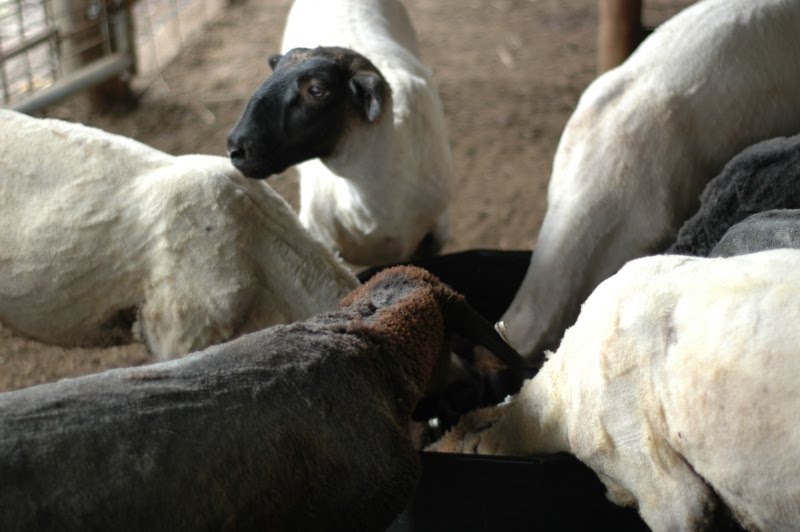
Just outside of my hometown lives a woman and her sheep. Mrs. Hamilton and her flock have provided me with most of the wool I've spent so much time washing. She used to throw it to the woods to compost and let the birds have their pick for nests after the annual shearing until my dad got wind of this and mentioned she and I should get to know each other. We did and not only did she offer to let me have it, but also delivered it. Such generosity!
As most shepherdesses do, she shears her flock in the spring, but she invited me at the beginning of the summer to help her liberate the lambs from their woolen coats before the harsh Florida heat set in. In the past she's lost a few to stress this time of year and hoped to avoid loss this year. It was my first time meeting the flock, and though we only handled the just weaned lambs I completely fell for them all. The ewes rested happily on the the other side of the fence just in sight and the lambs were lovely sweet things that nibbled my pant leg and Maaa'd! piteously when we haltered them and led them to the shearing area. With their shepherdess mama at their heads they were quite calm even if not entirely pleased with the whirring of the heavy duty shears.
Shearing was hot, tiring and total bliss. The concentration required is the same beautiful focus as sculpting or drawing. It's a study in unveiling a tender form: anticipate where the edges of bone rest directly against skin to avoid prodding with the steel teeth of the comb, manipulate the loose skin around the elbows to prevent pinching by the blades, soothing over the thin skin of the belly taut against the gut. The knowledge imprints on us wholly, in a way that just glancing at the animal in the field can never do.
Lifting their heads with one hand as I slid the shears against their necks elicited a visceral response . . . so near to the act of slaughter and yet entwined in protection. Both are shepherding in the most sacred of senses.
The black one in the front is PeeWee; he was just one pound at birth and survived with the help of bottle feeding.
This one was discovered to be dappled underneath. A watercolor lamb. . .
As we finished up and gathered up the bag of short lambswool, the skies darkened and Mrs. Hamilton led her oldest charge, a thirteen-year-old blind ewe to shelter. The ewe of clouded eye tiptoed into the barn among bales of hay and and settled in her own private stall built of hay bales, nibbling feed as the rain began to fall.
I'll return in spring.
7.21.2010
in the studio
This is a series of new tangle sculpture stacks. I am making four the same size. One is a commission piece and three more will expand the series. Though my objective with this work is to capture tangles, most of the labor that goes into sanding and polishing the edges. As a result, the sculpture transmits light nicely and it sort of disappears when seen from the side. Many hours go into this, but it is well worth the trouble. That clean detail makes me want to eat the thing.
Nine hours or so later, Side A is complete.
Onto Side B.
and then C and D.
A German friend of mine, Kisa, mentioned that they have a term for this kind of crazy task that must be done "du bist des Wahnsinns fette Beute" which google translates as "You are the fat booty of insanity".
With that as my mantra, I can't help but giggle as I sand.
7.19.2010
"When it rains, sheep become self-cleaning."
Over the last year one of my major ongoing studio tasks been washing loads of raw wool one after the other in my bathtub. I've been scouring them which means soaking the wool in hot water and detergent for a time, pulling them out while the water is still hot, draining them and the tub and repeating til the water is clear and then giving a couple rinse soaks at the end for good measure. It's work that uses a lot of hot water and detergent, means the bathtub is constantly full of wool in various states of dirty and, most importantly, any other work I'm doing is constantly interrupted to tend to it.
Recently I stumbled across about the Fermented Suint Method which seemed like a promising method to make the process more efficient. The Fermented Suint method was developed in New Zealand and involves soaking dirty raw wool in rainwater for several days. This works because of the self cleaning properties of wool. Judith MacKenzie McCuin explains:
"In addition to the coating of lanolin that happens during the passage through the tube of the [hair] follicle, wool is coated with a substance called suint.
Secreted from a gland similar to a sweat gland, suint is applied just before the fiber exits the skin. Suint is liquid at room temperature and hardens as it moves up the shaft of the fiber, away from the sheep's body heat. Like soaps and detergents, which are made from either sodium or potassium salts, the chemical composition of suint is primarily potassium salts, making suint a natural detergent. Unlike lanolin, suint is water soluble. Like all other soaps and detergents, suint naturally attracts dirt and surrounds it, moving the dirt up the wool shaft by osmosis towards the tips of the fleece. When it rains, sheep become self-cleaning. The rain activates the soapy qualities of the suint in the tips of the fleece and washes away much of the dirt. " ("On Washing Wool" Spin-off magazine, Fall 2008)
She goes on to mention that pioneers would run the sheep through rivers or creeks before shearing to wash the wool.
This is the first batch of fleece, which has been sitting in water for five days and is ready to come out. Future fleeces only need two days in the same bath of water.
That film on the top means it's healthy.
That stink means it's happy.
That cover means my neighbors won't hate me.
I have six buckets going right now and am using tapwater instead of traditional rainwater, if these fleeces were more expensive/delicate I'd probably try rainwater.Once rinsed and clean, the wool no longer smells sour. This process leaves some lanolin which I may decide to remove with my usual scouring method, but it will be much faster needing only one or two washes and rinses rather than several.
The vegetable matter is another issue altogether which will require lots of picking and combing in the future.
At the moment I'm expanding my drying racks to keep pace with the cleaning.
5.10.2010
sky fluff
We found this little guy in our garden yesterday and decided to take it for a fly. It trembled mightily as we tethered it carefully with silk thread and burst forth from our opened hands. After following the fluff for a time and then coaxing it to better currents, we bid farewell as it floated above the townhouse walls around us.
i think it's a thistle seed.
3.24.2010
3.17.2010
3.14.2010
In the studio today
Here you can see the tangle sculpture remake fully underway. Layer by layer I've been disassembling, throughly cleaning, and reassembling a new stack. I'll admit it's not my favorite project to work on, but hopefully I'll be pleased with the results.